Knowing how to change page size in Word is one of those small skills that quietly saves hours — the difference between a flyer that prints clean and one that gets cut off at the edges. Word ships with every standard paper size built in (A4, A5, Letter, Legal, Tabloid) and lets you punch in custom dimensions when you need something unusual, like a booklet or an oversize report. The setting lives next to page margins on the Layout tab.
In this guide, you’ll learn three ways to change page size in Word — the quick ribbon method, the full Page Setup dialog for custom dimensions, and how to change the size of just one page inside a longer document.
What Is Page Size in Word?
Page size is the physical dimensions of the paper your document is built for — the width and height that everything else (margins, columns, headers, images) sits inside. Get it wrong and the print comes out cropped, scaled, or shifted off-centre. Get it right and the document looks exactly the same on screen as it does on paper.
The most common sizes you’ll switch between are:
- A4 (210 × 297 mm) — the global standard for reports, letters, and school work
- A5 (148 × 210 mm) — half the size of A4, perfect for booklets and journals
- A3 (297 × 420 mm) — double A4, used for posters and large diagrams
- Letter (8.5 × 11 in) — the US default for business documents
- Legal (8.5 × 14 in) — longer than Letter, used for contracts
- Tabloid (11 × 17 in) — large format for newsletters and posters
Watch the Video Tutorial
If you prefer to see this in action, the full video walkthrough is below, showing each method step by step.
How to Change Page Size in Word: Step-by-Step
There are three ways to change page size in Word depending on what you’re trying to do — pick a preset from the ribbon, build a custom size in the Page Setup dialog, or resize just one page inside a longer document. The method you choose depends on whether you need speed, precision, or section-level control.
Method 1: How to Change Page Size in Word Using the Layout Tab
This is the fastest way to switch between standard paper sizes. The Size button on the Layout tab gives you every common preset in a single dropdown — A4, Letter, Legal, A5, Tabloid, and more.
- Open your document in Microsoft Word and click the Layout tab in the ribbon.
- In the Page Setup group, click Size.
- Pick the paper size you need from the dropdown list.
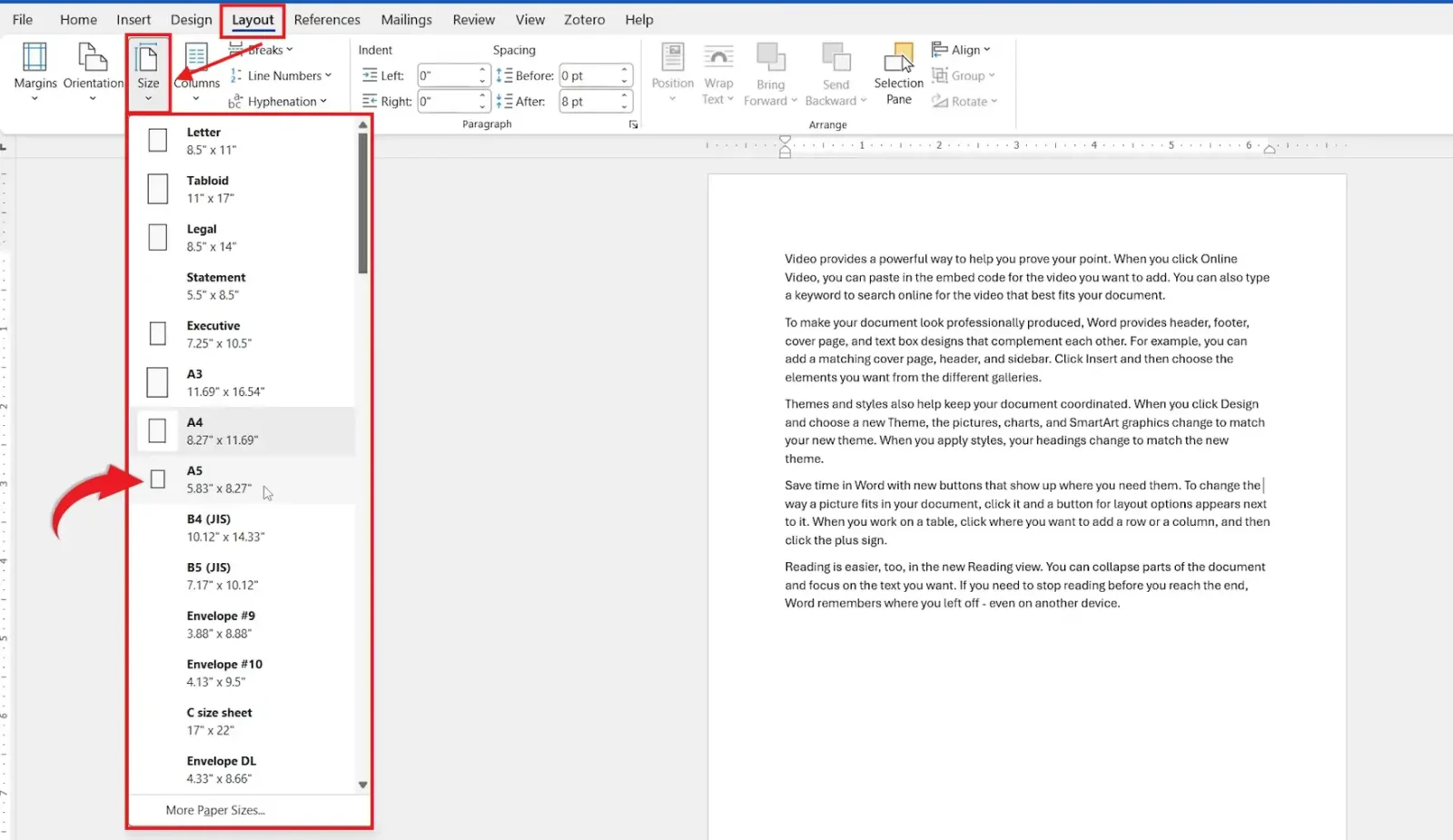
? Result: The whole document instantly resizes to the new dimensions. Text reflows, page count updates, and any images shift to fit the new layout.
Method 2: How to Change Page Size in Word With Custom Dimensions
When none of the presets match what you need — say you’re printing on a non-standard envelope, a square card, or specialty stock — open the full Page Setup dialog and type your own width and height.
- Click the Layout tab, then click Size in the Page Setup group.
- Scroll to the bottom of the dropdown and click More Paper Sizes.
- In the Page Setup dialog, enter your custom Width and Height values.
- Under Apply to, leave it on Whole document, then click OK.
[SCREENSHOT NEEDED #1 — filename: word-page-setup-dialog-custom-paper-size.webp | alt: Word Page Setup dialog with custom Width and Height fields highlighted for setting a custom page size in Word.]
? Result: Word builds a document at the exact dimensions you specified — useful for printing on label stock, custom envelopes, or any project where the standard sizes don’t fit.
Method 3: How to Change Page Size in Word for One Page Only
Sometimes you need a single page at a different size — a Legal-size appendix inside a Letter-size report, or a Tabloid page for a chart. The trick is section breaks. Without them, any size change applies to the whole document. This is the same technique used to rotate just one page in Word.
- Click at the very start of the page you want to resize.
- Go to Layout > Breaks > Next Page to insert a section break before it.
- Click at the very end of that same page and insert another Next Page section break, isolating the page in its own section.
- Click anywhere inside the isolated page, open Layout > Size > More Paper Sizes, enter your new dimensions, and set Apply to to This section. Click OK.
[SCREENSHOT NEEDED #2 — filename: word-page-setup-apply-to-this-section.webp | alt: Word Page Setup dialog with the Apply to dropdown set to This section for changing the size of one page in Word.]
? Result: Only the isolated page changes size. Every other page in the document keeps its original dimensions.
Which Method Should You Use?
| Method | Best For | Time Needed |
|---|---|---|
| Method 1 — Layout tab dropdown | Switching the whole document to a standard size (A4, Letter, Legal) | 10 seconds |
| Method 2 — Custom dimensions | Envelopes, cards, labels, or non-standard print stock | 1 minute |
| Method 3 — Single page only | Mixed-size documents (Legal appendix, Tabloid chart inside a report) | 2 minutes |
In most cases Method 1 is all you need. Reach for Method 2 only when the presets don’t fit, and Method 3 only when one page genuinely has to be different.
Common Problems When Changing Page Size in Word
Text overflows onto extra pages after resizing
When you shrink from A4 to A5, you’ve cut the available space roughly in half — so text reflows and pages multiply. Tighten line spacing, reduce font size by a point or two, or trim the page margins to claw the space back.
Images shift out of place
Images anchored to a specific position can end up floating off the page after resizing. Right-click each image, choose Wrap Text > In Line with Text, and they’ll reflow with the paragraphs instead of staying fixed to a coordinate.
The size change applies to the whole document when you only wanted one page
Without section breaks, Word treats the whole document as one section. Follow Method 3 above — insert section breaks before and after the target page, then set Apply to to This section instead of Whole document.
Custom page size won’t print correctly
Most home printers can only print to a fixed set of paper sizes. If your custom dimensions don’t match anything your printer supports, the output gets scaled or cropped. Check your printer’s paper handling settings, or export the document as a PDF first to lock the layout before printing.
Pro Tips for Better Page Layouts
- Set page size before you start writing — changing it later usually means rebuilding the layout from scratch.
- Match your page size to your printer’s loaded paper. If they don’t match, the printer will scale (and stretch) the output.
- Pair size changes with the right margins — see how to adjust margins in Word so the new dimensions don’t leave too much (or too little) white space.
- Use Print Preview (Ctrl + P) after every resize. It catches cropped images and broken layouts before they reach the printer.
FAQs
How do I change page size in Word?
To change page size in Word, click the Layout tab, click Size in the Page Setup group, and pick your paper size from the dropdown. The whole document resizes instantly.
What is the default page size in Word?
Word defaults to A4 (210 × 297 mm) in most regions and Letter (8.5 × 11 in) in the United States. The default follows the regional settings on your computer.
Can I create a custom page size in Word?
Yes. Click Layout > Size > More Paper Sizes, type your own Width and Height into the Page Setup dialog, and click OK. Word supports any custom size your printer can handle.
How do I change page size for one page only in Word?
Insert section breaks before and after the page using Layout > Breaks > Next Page, open Size > More Paper Sizes, enter the new dimensions, and set Apply to to This section.
Why does my formatting change after resizing the page?
Different paper sizes hold different amounts of content, so text reflows, line breaks shift, and floating images move. Always preview your document after a size change to catch layout problems early.
Should I change page size before typing my document?
Yes. Setting the right page size at the start prevents formatting headaches later. Changing the size after writing usually means reworking margins, image placement, and page breaks throughout the document.
What’s the difference between A4 and Letter size in Word?
A4 (210 × 297 mm) is taller and narrower than US Letter (216 × 279 mm). A4 is standard worldwide; Letter is standard in the US and parts of Canada. They’re close enough that documents often look similar but won’t print identically on the wrong paper.
Conclusion
Knowing how to change page size in Word covers about 90% of the layout problems people run into when preparing documents for print. Three methods, three use cases — preset sizes for everyday work, custom dimensions for unusual stock, and section breaks when only one page needs to be different.
Once the page size is locked in, the next step is usually fine-tuning the white space around it — start with the guide on how to adjust margins in Word.
Related Tutorials

Recent Microsoft Word Tutorials

Looking for more help with Microsoft Word? Browse all step-by-step Word tutorials covering formatting, layout, pages, and document setup.
? View all Microsoft Word tutorials: https://wordmadeeasy.halmanweb.com/microsoft-word/
? Need more support – check out the official guidance: https://support.microsoft.com/en-au

Prefer watching instead of reading? Many Word tutorials are also available as short, step-by-step videos on the Word Made Easy YouTube channel.